
Prove you are ready to bid for public contracts.

Public contracts are lost to gaps that could have been closed: an insurance certificate that lapsed, a mandatory question with no approved answer, a tender nobody saw until the week it closed. BidProof keeps a supplier’s evidence, approved answers and sign-offs in one place, shows its readiness against the frameworks buyers use, and tells it what is due and what is coming to market. When a buyer asks for proof, the supplier shares a pack that is checked again every time it opens.

It is built around the Procurement Act 2023: assessment summaries, the standstill period, exclusion grounds and the Central Digital Platform. It is for bid teams at suppliers to UK public bodies, and for the consultancies that support several clients at once.

BidProof is live at bidproof.co.uk.

Every screen on this page uses Northwind Facilities Ltd and Partner Consultancy, invented organisations with synthetic records. No real supplier appears.
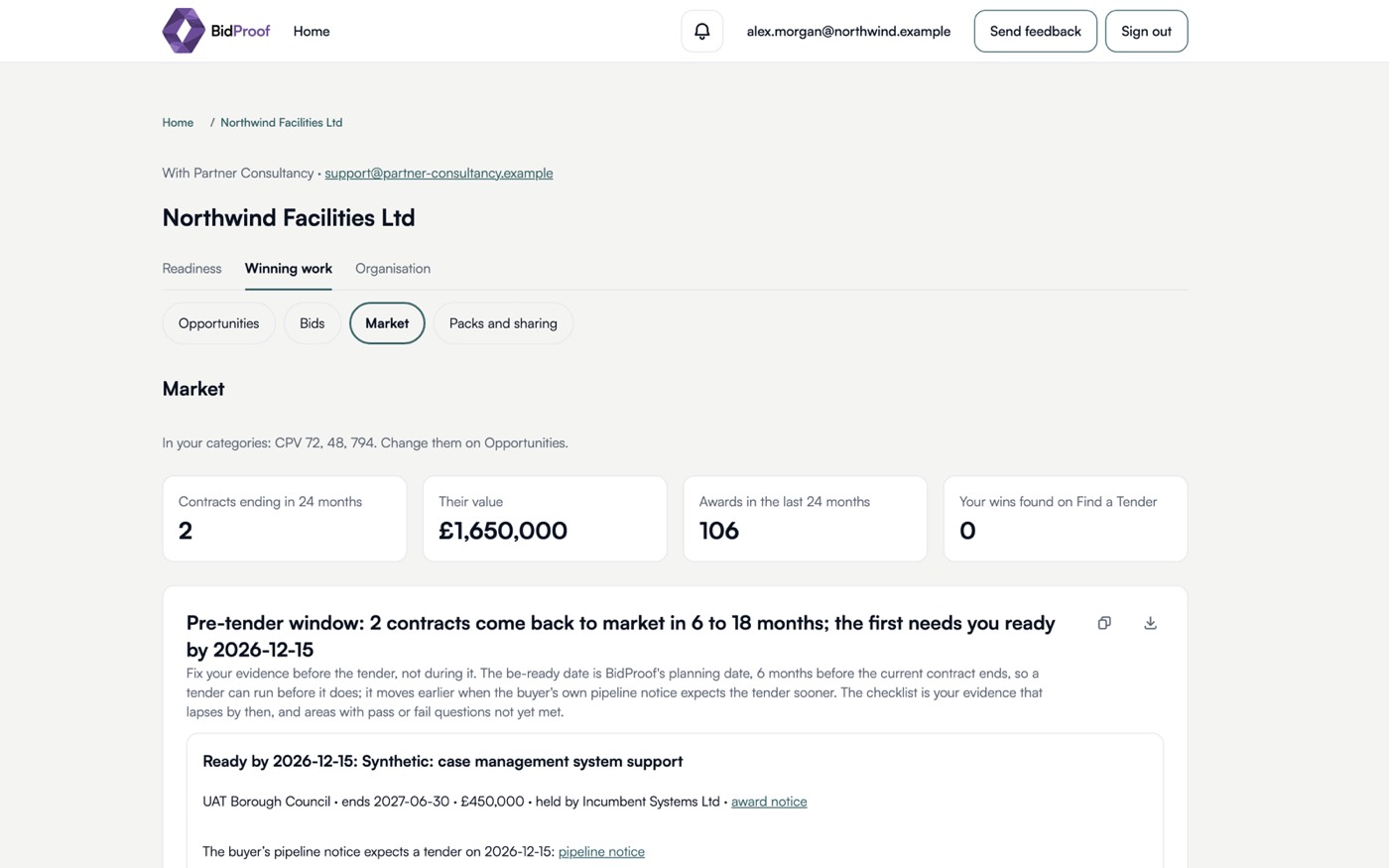
The BidProof market screen for Northwind Facilities Ltd: contracts in its categories ending in 24 months, their value, recent awards and a pre-tender window with a be-ready date

Three questions a bid lead should be able to answer.

Most suppliers hold the documents. Few can say, on the day, whether they would pass, what falls due before the next tender closes and why the last bid scored as it did.

Are we ready to bid?

Every question not yet met is ranked, pass or fail first, then by weight and due date, each with an owner and an action. Pass or fail questions and scored coverage are shown apart, never blended into one misleading score.

What is due?

Tenders closing, framework windows opening, evidence expiring and gap actions, week by week, with what stands in the way of each. The end of a standstill period is worked out from the award notice.

What did the last bid teach us?

The buyer’s assessment summary is recorded against the answer used, criterion by criterion, so the answers that lose marks are flagged before they go into the next bid.

Everything held against the bid it supports.

One record per organisation, built from the evidence, answers and sign-offs that a bid rests on, and the opportunities it is working towards.

Evidence, answers and sign-offs

  • Certificates, policies and insurance, each with an owner, a review date and an expiry
  • Answers written once, approved by a named person and reused
  • Readiness against procurement frameworks and the Algorithmic Transparency Recording Standard
  • A daily Companies House check against the exclusion grounds in the Procurement Act

Opportunities, bids and the market

  • Find a Tender notices matched on categories, regions and contract size, with the reason
  • Bid and no-bid decisions recorded with the person who approved them
  • Assessment summaries and the eight-working-day standstill for every bid
  • Contracts in your categories coming back to market in 6 to 18 months, with a be-ready date

What your bid team and your clients actually see.

The main screens in the product, shown with the Northwind Facilities Ltd and Partner Consultancy organisations.

Market

Contracts in your categories that are due back on the market in six to eighteen months, with their value, the incumbent and a date by which you need to be ready. Each one carries a checklist of evidence to renew and gaps to close, so preparation starts before the tender is published.

The BidProof market screen: two contracts ending in 24 months, their value, 106 awards in the last 24 months, and a pre-tender window with a be-ready date

Opportunities

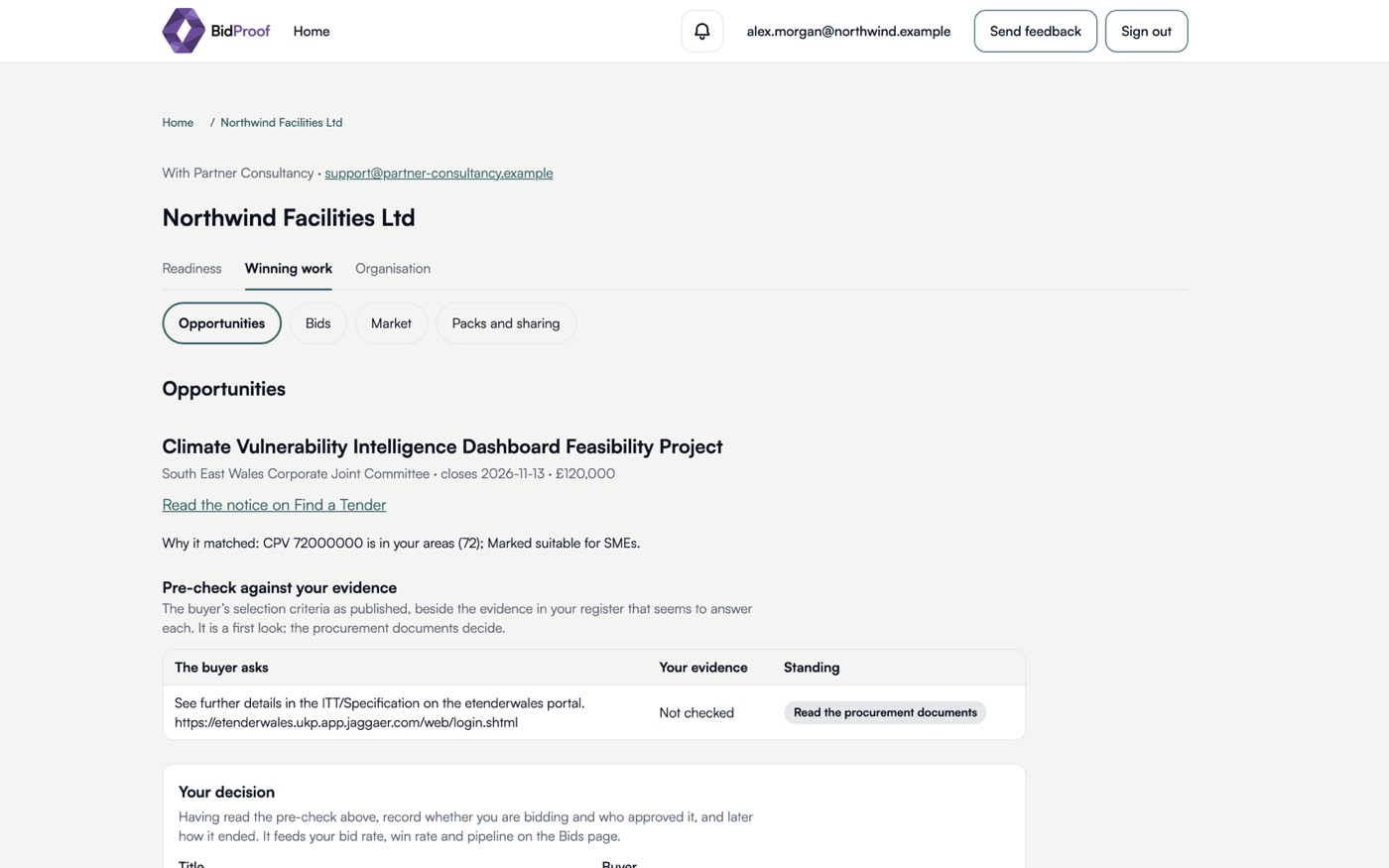
New tenders that fit your categories arrive with the reason they matched. A pre-check sets the buyer’s published selection criteria beside the evidence that seems to answer each, and the bid or no-bid decision is recorded on the same page, with who approved it. The procurement documents decide.

A BidProof opportunity: a Find a Tender notice with why it matched, a pre-check against the organisation's evidence and a decision form

Bids

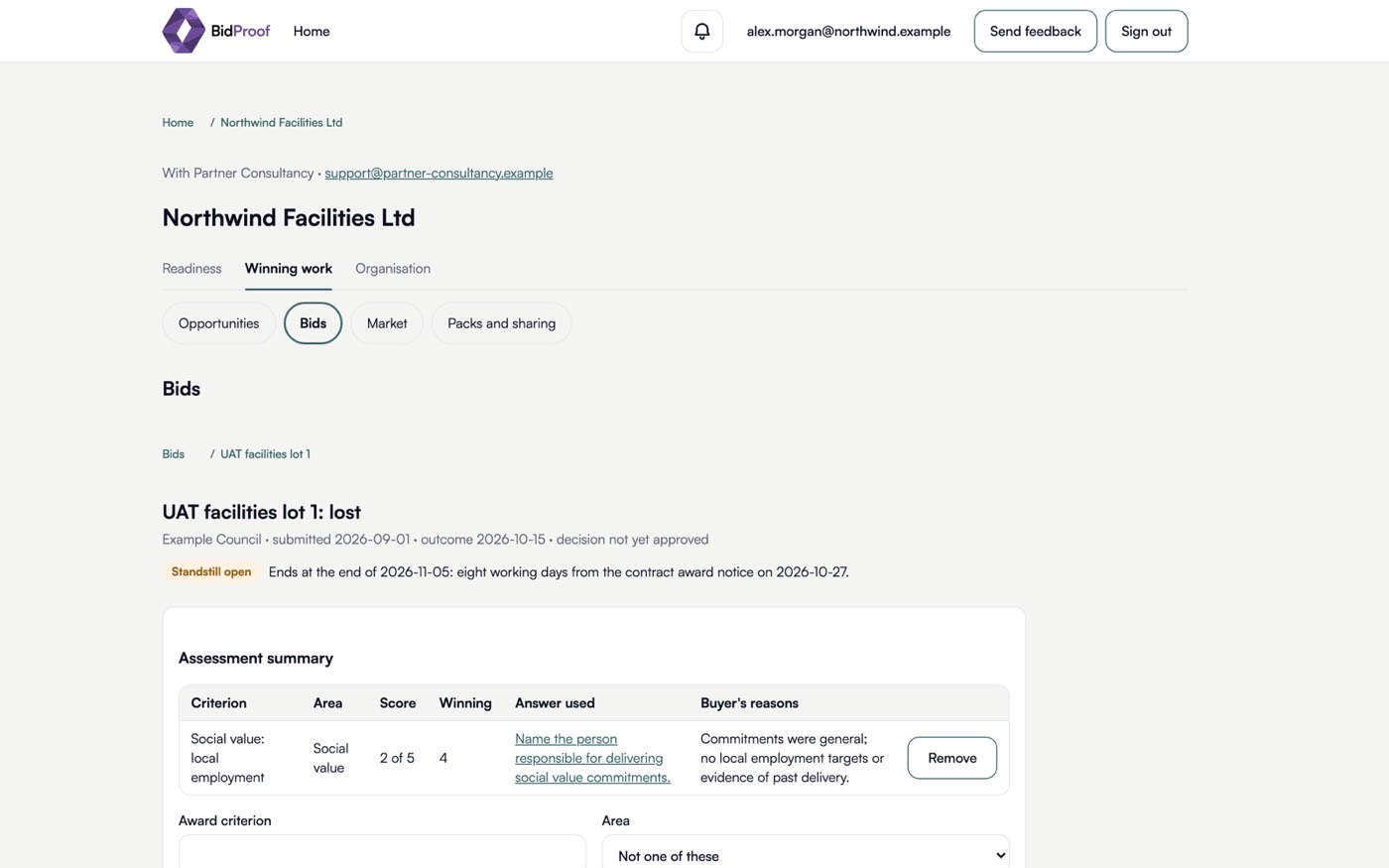
Each bid has its status, the end of the standstill period worked out from the award notice, and the assessment summary: every criterion’s score, the winning score, the buyer’s reasons and the answer that was used. Every result becomes a lesson for the next one.

A BidProof bid record marked lost, with the standstill end date and an assessment summary scoring one criterion two of five against a winning four

What the buyer sees

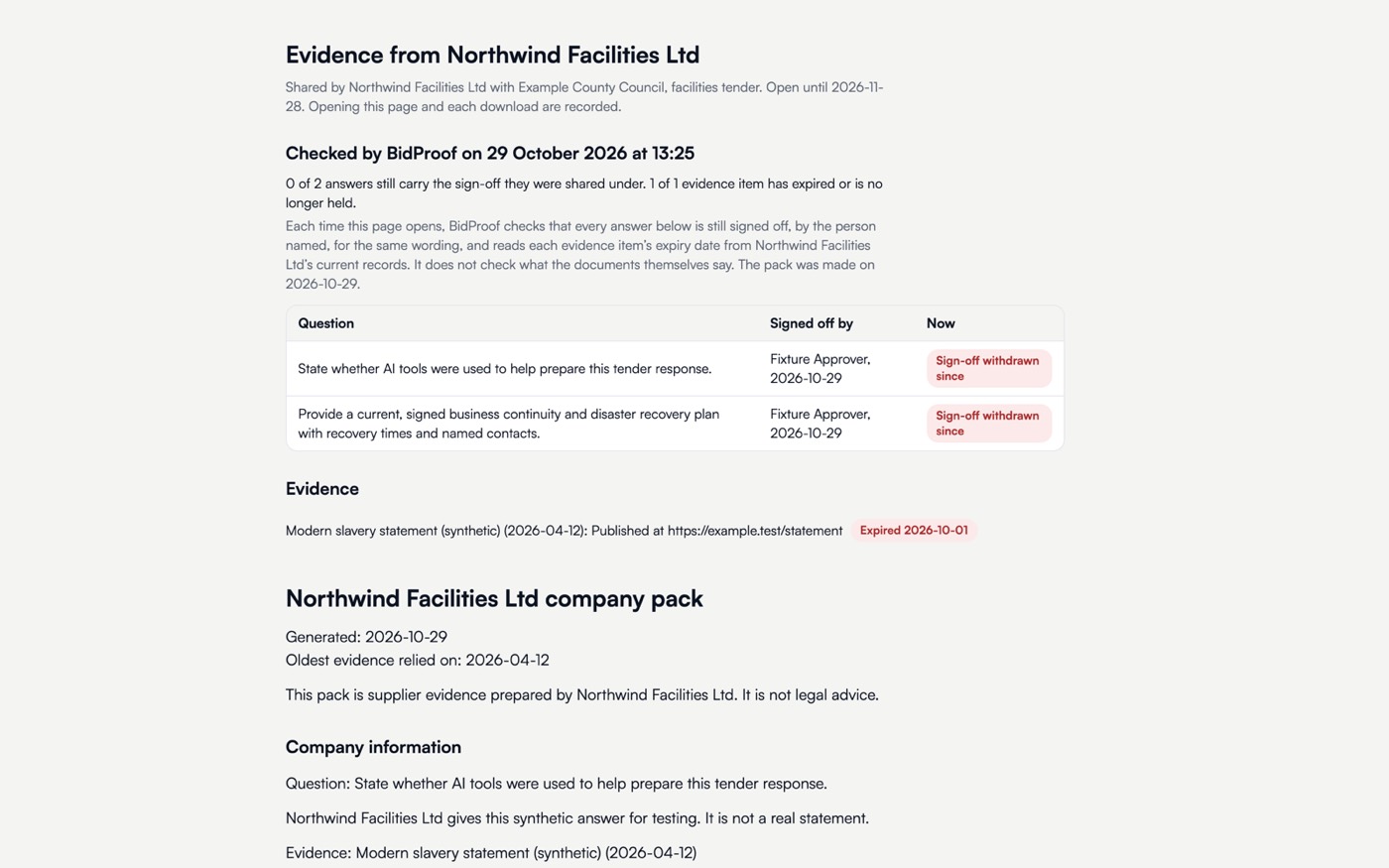
A shared pack opens without an account. Each answer shows who signed it off and when. Every time the page opens, BidProof checks that each sign-off still stands for the same wording and reads each evidence item’s expiry from the live record, and it says plainly what it does not check. Every opening and download is recorded.

A BidProof evidence room as a buyer sees it: the date it was checked, two answers whose sign-off has been withdrawn since sharing, and an expired evidence item

Partner portfolio

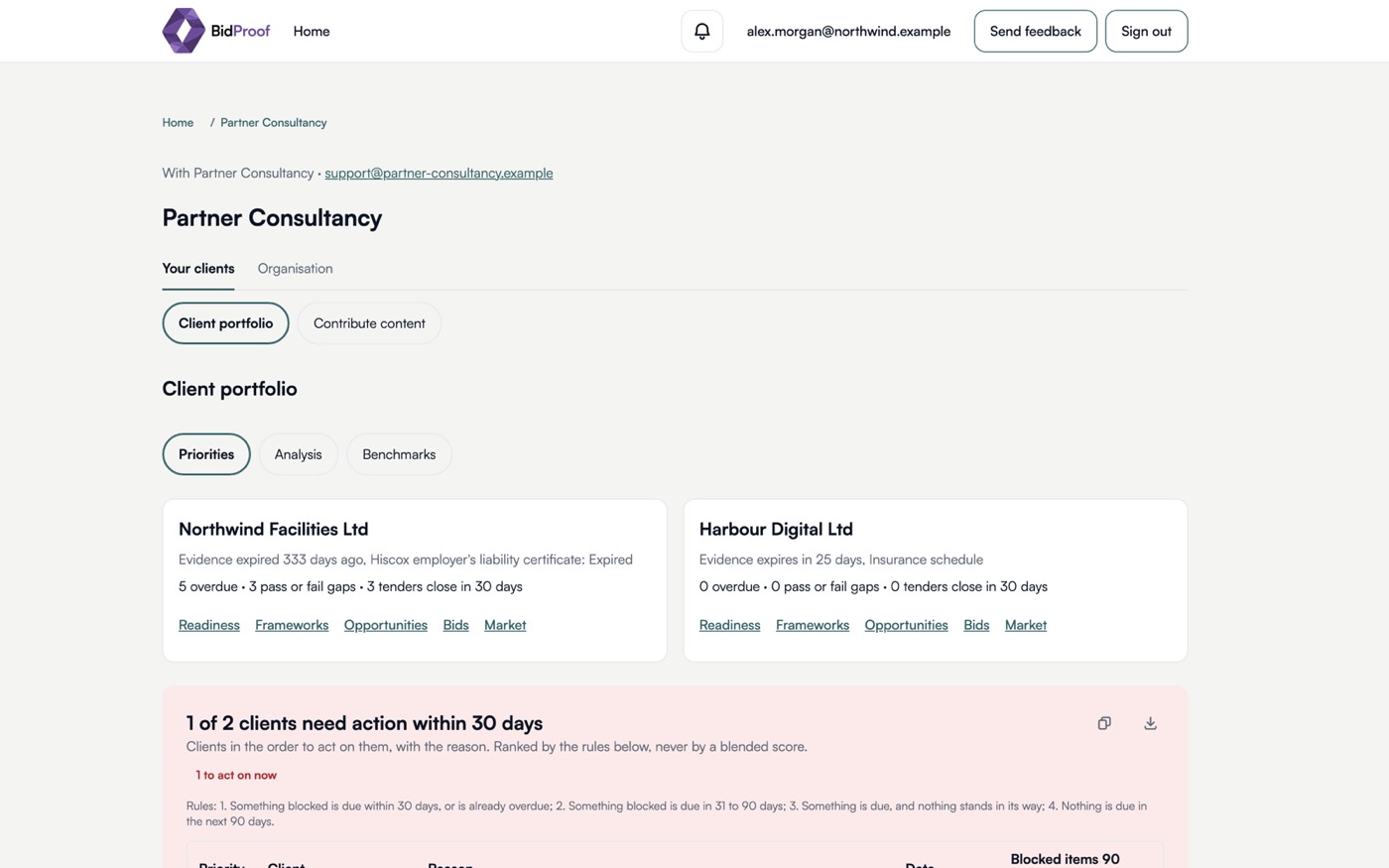
A consultancy sees its clients side by side under its own brand, ranked by published rules rather than a blended score: what is blocked, and when it is due. The client who needs help first is obvious, and the reason is stated. A client decides whether its partner can see it, and can withdraw that at any time.

The BidProof partner portfolio: two clients with their overdue items, pass or fail gaps and tenders closing, and one of two flagged for action within 30 days

Overview

The week starts with what must be fixed or decided now: notices awaiting a decision, pass or fail gaps open, evidence expiring within 60 days and the next tender closing. The items in the way are listed in the order to act on them, and each opens the page where it is resolved.

Evidence register

Every certificate, policy and document a bid depends on is held once, with its owner, review date and expiry. Expired and soon-due items lead the list. When a certificate is renewed, every answer that relied on it is brought back into line, and nothing stays signed off on lapsed evidence.

Answers

Each question shows where its sign-off stands, the buyer’s past scores and reasons for the answer, and the evidence it rests on. Shared facts such as the company name fill in automatically, with a preview of how the answer reads in a pack.

Frameworks

Readiness by framework and by area, with the questions not yet met at the top. A single readiness percentage can hide the one mandatory question that excludes a bid, so pass or fail areas and scored coverage are always shown apart.

What changes for your bid team.

A pass or fail question is never hidden inside a readiness score.
Nothing stays signed off on evidence that has lapsed.
The pack a buyer opens is checked again every time, so trust rests on current facts.
A consultancy sees a client only while the client allows it.

Show a buyer proof on demand.

Create an organisation on bidproof.co.uk and start with the evidence you already hold. How to buy is agreed with ThinkTribal directly.